


Views: 0 Author: Site Editor Publish Time: 2026-07-14 Origin: Site


Regulatory scrutiny, corporate environmental mandates, and consumer safety pressures are escalating rapidly around the chemical composition of point-of-sale receipt paper. Enterprise procurement teams face mounting challenges to ensure compliance while protecting staff and customers. Often, organizations transition from standard paper to a BPA free thermal paper roll to meet basic compliance requirements. However, this creates a regrettable substitution trap. Manufacturers frequently substitute BPA with BPS (Bisphenol S), a chemical facing identical endocrine-disrupting health backlash and impending regulatory bans across multiple global jurisdictions.
Evaluating true phenol free thermal paper rolls is a business-critical necessity. Shifting to a complete BPA BPS free thermal paper standard future-proofs supply chains. It mitigates occupational health liabilities for checkout staff and aligns with tightening global chemical regulations like EU REACH Annex XVII, California Proposition 65, and Washington State's Safer Products Act.
Chemical Distinction is Critical: "BPA-free" does not mean phenol-free; it often contains BPS. Only a certified "phenol free thermal paper roll" guarantees the complete absence of all bisphenol developer compounds.
Regulatory Future-Proofing: Transitioning directly to phenol free thermal paper rolls eliminates the need for repeated, costly procurement cycles as legislation globally moves to phase out BPS and other phenolic developers.
Supplier Verification is Mandatory: Procurement teams must demand third-party lab verification (HPLC or GC-MS testing) rather than relying on basic marketing declarations, as mislabeling in the global thermal paper roll supplier market remains a documented risk.
Understanding how thermal paper functions requires looking at its developer chemistry. The paper features a heat-sensitive coating containing dye precursors, such as fluoran. It also contains acidic chemical developers that react when exposed to the heat of a thermal printhead. This reaction produces the black text and images you see on a standard receipt. Historically, Bisphenol A (BPA) served as the primary developer. When health concerns arose, the industry shifted toward alternatives.
The structural similarities between Bisphenol A (BPA) and Bisphenol S (BPS) created a massive loophole. Toxicological studies demonstrate that BPS behaves as a persistent endocrine disruptor. It presents similar dermal absorption risks to human health. Standard BPA-free claims fail modern corporate compliance because they ignore the hazards of BPS. Cashiers and consumers handling these receipts remain exposed to harmful chemicals.
True phenol-free alternatives eliminate these risks entirely by utilizing different chemical or physical mechanisms. We see three main categories dominating the compliant market:
Sulfonylurea-based developers: Compounds like Pergafast 201 contain no phenolic hydroxyl groups, offering a safer chemical reaction.
Vitamin C/ascorbic acid-based developers: These are natural, non-toxic alternatives perfectly suited for eco-focused brands prioritizing sustainability.
Physical-imaging technology: Non-chemical solutions use a physical barrier layer that turns blue upon thermal contact. This eliminates chemical developers entirely.
The European Chemicals Agency (ECHA) enforces strict restrictions on BPA in concentrations equal to or greater than 0.02% by weight under EU REACH regulations. Regulatory bodies are currently conducting ongoing assessments targeting BPS for similar bans. The regulatory landscape shifts rapidly, forcing companies to adapt their procurement strategies proactively.
North American legislation follows suit with aggressive state-level initiatives. California's Assembly Bill (AB) 647, Washington State's Safer Products initiatives, and New York State's bans on bisphenols in thermal paper highlight the growing legal framework. These laws aim to remove toxic phenolic compounds from everyday consumer interactions.
Enterprise retail, healthcare, hospitality, and banking brands face significant liabilities. Failing to phase out phenolic compounds before legislative mandates occur exposes organizations to legal challenges, occupational safety grievances, and severe public relations damage. Proactive transition strategies protect brand reputation and ensure uninterrupted operations.
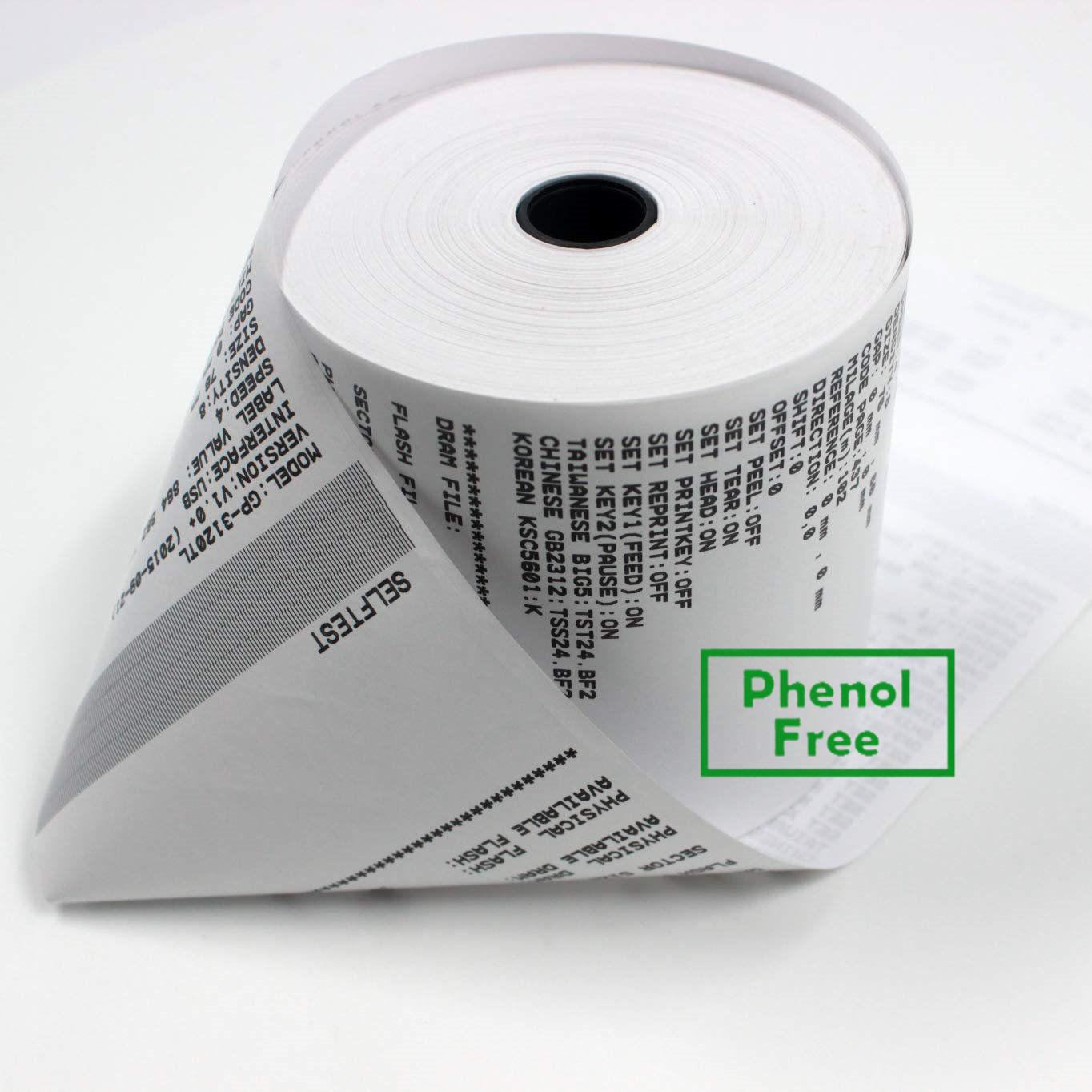
Image density and print contrast are vital metrics for receipt legibility. A standard BPA free thermal paper roll provides adequate contrast under normal conditions. However, premium phenol free thermal paper rolls often deliver superior black-line density under standard point-of-sale printing speeds. This ensures barcodes scan correctly and text remains crisp.
Archival lifespan differs significantly between chemical formulations. Standard thermal paper typically maintains legibility for 5 to 7 years. In contrast, phenol-free and physical thermal papers guarantee 10 to 35 years of legibility under proper storage conditions. This extended lifespan matters heavily for tax compliance, warranty claims, and medical record retention.
Resistance to environmental degradation is another critical factor. Phenol-free coatings react differently to heat, humidity, and UV light exposure. They also offer better resistance to oils, including hand creams and sanitizers. Furthermore, they withstand plasticizer exposure better, meaning receipts stored in PVC sleeves will not fade prematurely.
Grammage, measured in grams per square meter (gsm), dictates the operational efficiency of the paper. Standard paper weights include 48gsm, 55gsm, and 80gsm. Lower-weight paper allows for longer roll lengths per roll diameter. This reduces the frequency of roll changes, optimizing labor efficiency at busy checkout lanes.
Roll configuration and core types must align with legacy hardware. Core materials range from plastic and recycled cardboard to coreless designs. Roll dimensions, including width, outer diameter, and inner core diameter, require precise matching to ensure absolute compatibility with installed point-of-sale hardware.
Pre-printing and branding compatibility require careful evaluation. Phenol-free thermal coatings interact specifically with back-side pre-printing for return policies, warranty details, and branding logos. Procurement teams must identify the specific ink types required. Water-based inks generally perform better than UV-cured inks, preventing chemical reactivity and premature paper activation.
Occupational exposure for cashiers drives the adoption of safer paper. Clinical research highlights significant dermal absorption rates of bisphenols for front-line cashiers. These employees handle standard paper receipts multiple times per hour, accumulating exposure over their shifts. Eliminating bisphenols protects workforce health.
Recyclability and waste stream contamination represent major environmental concerns. Bisphenol-coated papers contaminate the paper recycling stream, introducing toxic chemicals into recycled products. Conversely, BPA BPS free thermal paper supports zero-waste initiatives. It matches the strict standards of municipal recycling programs, promoting a true circular economy.
Evaluation Metric | BPA-Free / BPS-Containing | True Phenol-Free (BPA/BPS-Free) |
|---|---|---|
Regulatory Compliance Risk | High (Subject to BPS bans) | Zero (Future-proofed) |
Archival Lifespan | 5 - 7 Years | 10 - 35 Years |
Environmental / Recyclability | Contaminates recycling streams | Safe for standard recycling streams |
Dermal Absorption Health Risks | High (BPS acts as disruptor) | None / Minimal |
Procurement teams must demand rigorous independent laboratory testing. High-Performance Liquid Chromatography (HPLC) or Gas Chromatography-Mass Spectrometry (GC-MS) test reports are essential. You must obtain these reports from your thermal paper roll supplier to prove the 100% absence of bisphenols. Marketing claims fail without scientific validation.
Standard certifications provide additional layers of assurance. Require the following documentation during the vetting process:
FSC (Forest Stewardship Council) / PEFC Certification: Guarantees sustainable wood sourcing for the base paper.
ISEGA Certification: Certifies the thermal paper is safe for direct contact with food products.
OEKO-TEX Association / Eco-Labeling: Verifies non-toxicity and overall chemical safety.
Safety Data Sheets (SDS): Mandate the inspection of Section 3 (Composition/Information on Ingredients) to confirm the specific developer compound used.
Abrasiveness directly impacts printhead lifespan. High-quality top-coated phenol-free papers must meet non-abrasive standards. This prevents premature printhead failure and reduces hardware maintenance requirements. Analyzing the physical impact of phenol-free coatings on thermal printheads ensures long-term operational stability.
Residue and dust accumulation cause significant hardware issues. Lower-quality, non-branded thermal papers shed paper dust or chemical residue. This buildup leads to printhead burn-outs and jammed mechanisms. Advise your technical teams to conduct pilot tests using existing point-of-sale and kiosk printers to verify paper quality before large-scale deployment.
Environmental tolerances dictate how paper must be stored. Phenol-free papers require storage temperatures below 35°C (95°F). Relative humidity must remain below 60% to prevent premature thermal activation. Proper warehouse climate control is non-negotiable for maintaining paper integrity.
Warehouse turn management ensures optimal performance. Implement strict First-In, First-Out (FIFO) inventory protocols. This optimizes thermal coating stability across distribution centers, ensuring older stock is utilized before environmental degradation can occur.
Understanding the tiers of the supply chain is critical. Differentiate between manufacturers, converters, and distributors. Buying from middle-tier distributors carries risks if they cannot verify the chemical source. Ensure the supplier can trace base paper parent rolls back to accredited mills.
Chain-of-custody documentation proves compliance. Outline a clear process for auditing a supplier's chain of custody. You must ensure the "phenol-free" label is maintained accurately from chemical application at the paper mill to the slitting and packaging facility.
Developer material availability impacts supply chain reliability. Assess the supplier's access to phenol-free developers, such as Pergafast chemical lines. These materials are often more supply-constrained than standard bisphenols. Confirming robust supply agreements prevents unexpected shortages.
Logistics protection during shipping preserves paper quality. High heat and humidity during oceanic or cross-country shipping can pre-activate entire pallets of thermal paper. Require climate-monitored environments for all shipping containers. Establish inventory buffers and multi-sourcing strategies to mitigate logistical delays and ensure continuous operational supply.
Request HPLC or GC-MS laboratory test reports from your current suppliers immediately to verify chemical composition.
Initiate a pilot testing program with certified phenol-free rolls across a small sample of your existing printer hardware.
Update your procurement specifications to mandate FSC certification and the explicit exclusion of all bisphenol compounds.
Audit your warehouse storage conditions to ensure temperature and humidity controls meet the requirements for phenol-free paper stability.
A: BPA-free paper simply removes Bisphenol A, often replacing it with Bisphenol S (BPS), which carries similar health risks. Phenol-free paper eliminates all bisphenol compounds entirely, using safer alternatives like sulfonylurea or Vitamin C-based developers.
A: Yes, phenol-free thermal paper is designed to be fully compatible with standard direct thermal printers. You only need to ensure you order the correct physical dimensions and core sizes for your specific hardware.
A: High-quality phenol-free thermal paper offers superior image stability. Under proper storage conditions away from extreme heat, UV light, and humidity, these receipts can maintain legibility for 10 to 35 years.
A: Yes. Because it does not contain toxic bisphenols, true phenol-free thermal paper can be safely processed in standard municipal paper recycling streams without contaminating recycled paper products.
A: You must request independent third-party laboratory test reports, specifically HPLC or GC-MS testing. Do not rely solely on marketing claims; verify the Safety Data Sheets (SDS) for the exact chemical composition.


